

Refinancing to a better deal on your home loan can save you tens of thousands of dollars over the life of your mortgage.
But some people hesitate to pursue an alternative out of fear they will hurt their credit score.
It is true that a series of rejected loan applications in a short space of time can damage your credit report, but refinancing a mortgage is generally a positive long term move.
In this article, we’ll discuss how to find the best refinance deal without any long term damage to your credit file.
How Refinancing Changes Your Credit File
There are specific reasons why a credit score will fluctuate through the refinancing process. All of which will settle down very quickly after making the switch.
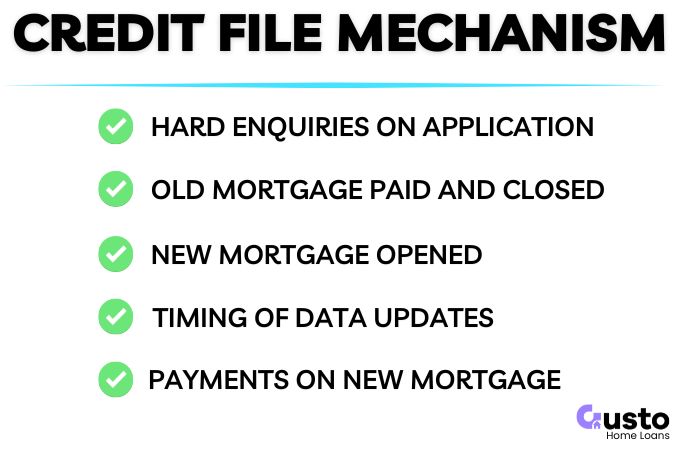
Three mechanics impact your credit file during this transition:
- Hard enquiries: A new mortgage application registers a hard enquiry, causing an immediate score dip.
- Account updates: The new loan appears on your file, while the outgoing mortgage closes and updates to ‘paid’.
- Reporting lags: Timing delays between banks and credit bureaus can temporarily make your report look messy, even if you do everything perfectly.
Any dip are likely to correct itself within a couple of months.
As you start to make payments on your new home loan the track record of stability will feed into your score and potentially boost it to a higher point than before the refinance. .
Ultimately, lenders care far more about your overall risk profile and steady repayment conduct than a temporary score movement.
Managing Soft and Hard Credit Enquiries
It is critical that any shopping around you do for a lower interest rate does not do unnecessary damage to your score.
Every home loan application you make directly to a lender will result in a hard enquiry and a hit to your credit score.
Multiple hard enquiries close together is a red flag and can be interpreted as a sign of financial distress.
This can take much longer to recover from and should be avoided.
So, how do you compare lenders without making direct applications?
One option is to use a broker such as Gusto Home Loans.
They will conduct a preliminary assessment and a soft credit enquiry.
This allows them to view your credit report for the purpose of matching you with the lender that offers the best deal, and is most likely to approve your application.
So you have more certainty about the outcome, confidence that you are getting the best rate, and until you commit to a formal application your credit score is untouched.
Average Account Age on Credit File
Closing an older, consistently paid loan, technically reduces your average account age. This can also impact your credit score but the effect is usually minor.
If you hold other long-standing credit cards or personal loans, your profile will remain more stable.
The real danger isn’t the account closure, but any messy financial conduct during the transition.
Missing a payment or applying for new debt while switching lenders causes longer term damage.
Rate-and-Term vs Cash-Out Refinancing
A standard rate-and-term refinance simply swaps your existing mortgage for a new one.
A cash-out refinance increases your total loan balance to release equity as cash.
Both options impact your credit score based on the factors discussed so far. However, there are broader implications to consider when you increase your overall debt levels.
Your debt-to-income ratio will increase, which can increase your credit risk profile.
The higher repayments will also reduce any future borrowing capacity you have, although this does not impact your credit score.
Is it Worth Refinancing Despite the Credit Score Hit?
If you can access a better home loan now and save money over the long term then the credit score fluctuations are mostly irrelevant.
What good is a credit score if it cannot help you access cheaper finance, right?
The only circumstance where you may need to delay a refinance is if you have a mortgage pre-approval, or upcoming settlement, on another property that you need to protect.
Outside of this, there is no reason why you shouldn’t pursue the cheapest possible mortgage rate.
Frequently Asked Questions
How many points will my credit score drop when I refinance?
Borrowers typically experience a small, temporary dip that will vary by individual circumstances. The exact impact depends on your recent credit activity, existing repayment history, and the overall strength of your financial profile.
How long do mortgage refinance enquiries stay on my credit report?
Hard enquiries remain visible on your credit file for five years. However, their scoring impact fades quickly. Lenders usually only focus on applications made within the last 12 months when assessing your risk.
Can I get mortgage refinance quotes without a hard enquiry?
Yes, if you use a broker. They can provide indicative pricing using a soft credit check that will not impact your score. A hard enquiry will not take place until a formal application is submitted.
Should I refinance before applying for another loan?
Sequence your applications carefully. Multiple hard enquiries in quick succession is a high risk signal. So, secure your most important loan first, then potentially wait a few months before applying for other forms of finance.
Will refinancing with the same lender avoid a credit hit?
Not necessarily. Switching products internally often requires a full financial reassessment. Ask your current bank to process a simple loan variation rather than a brand new credit application to protect your score.
Refinancing and Your Credit Score
Any credit score impact is short-term, driven by new enquiries and account changes.
This will work itself out in a few months assuming there are no other major changes to your credit profile.
You can protect your credit score through this process by making sure your repayments are consistent, limit formal mortgage applications, and avoid other new debt mid-refinance.
If you are considering refinancing then book a free strategy call with a Gusto Finance broker. We can calculate your potential savings while protecting your credit score.
