

If you plan on taking advantage of the various first home buyer assistance programs in Australia then at some stage you will have to live in the property.
However, the minimum timeframes to qualify are actually quite short if you plan to hold the investment long term.
But you need to be very careful not to breach the rules or you may incur expensive clawbacks of any benefit you received.
This can become complex if you are engaging in multiple state and federal programs to buy that first property.
If you only want an investment property then there are no such restrictions, but you will not longer qualify for any first home buyer assistance.
So, is the trade off worth it?
In this article, we’ll discuss the pathways to getting the best of both worlds and when it can make sense to give up the assistance altogether.
Pathways to First-Time Buyer Property Investment
A well bought investment property can be a smart way to accelerate your savings for the future.
The problem is that if your end goal is to buy a principal residence you will have to give up any future government assistance if you invest in property first.
No matter how small, or remote, the investment is compared to your desired property.
So, you must choose between two strategies.
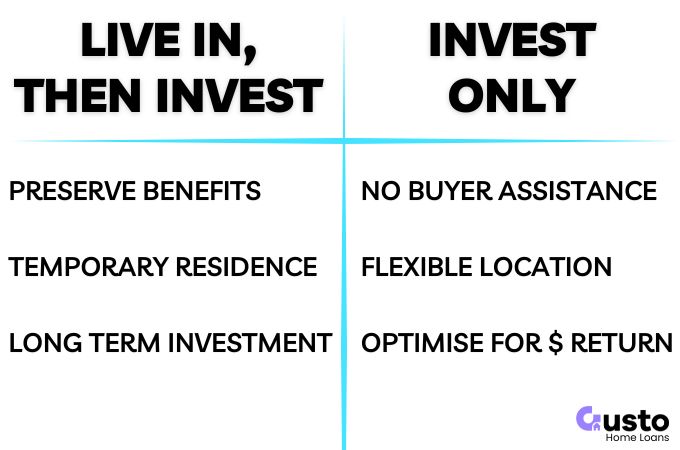
1. Buy as a pure investment
Renting the property out immediately means you forfeit first-home buyer incentives tied to owner-occupancy.
Lenders will also assess you differently with the expected rental income being factored into your borrowing capacity.
However, you can also expect higher interest rates attached to that investment loan.
This approach allows you to buy in the best possible location that is within your budget.
In most cases, a sound investment strategy will outpace the dollar value of any government incentives anyway and this option should not be dismissed.
If you are priced out of buying in, or near, your desired location then this can make a lot of sense long term.
Start building a portfolio now and upgrade your primary residence later.
2. Live in First Home For the Required Minimum Timeframe
Yes, you will have to move twice in this scenario.
You may also have to live in an area that is not your preferred location, but is a superior investment.
Most capital cities have affordable suburbs that may be further out and toughing out a longer commute for 12 months could be an excellent long term financial decision.
You will retain your first-home buyer grants and stamp duty concessions provided you satisfy the strict residency rules that apply under each program you use.
Why Invest Over Owning Your First Home?
The short answer is affordability. You rent where you want to live, and buy where you can afford (and will be a strong investment).
This is called rentvesting and is a strategy that is becoming more popular amongst younger people who simply cannot afford the million dollar homes in most capital cities.
It bridges the gap between your lifestyle preferences and your borrowing capacity and allows you to get ahead over time if you buy well.
Getting into the market sooner usually beats trying to out-save rising property prices.
Rental income helps your cashflow and over time you can accumulate a healthy equity stake in the property.
You can use this to either buy more properties, or sell and redirect the money towards a home that you actually want to live in.
Another major benefit is flexibility. You can relocate for work or family at any time and your asset just keeps ticking away untouched.
State Based First Home Buyer Grants and Occupancy Rules
First-home benefits do not operate under a single policy.
Your First Home Owner Grant (FHOG), stamp duty concessions, and federal schemes will all carry different occupancy tests.
Most government programs have both a minimum continuous occupancy requirement, and a deadline that you must move in by.
Below is a state by state summary for these two critical timeframes when buying existing dwellings (accurate on the day of publishing):
| State | Occupancy Deadline (post settlement) | Minimum Occupancy |
|---|---|---|
| NSW | 12 months | 6 months |
| VIC | 12 months | 12 months |
| QLD | 12 months | 6 months |
| WA | 12 months | 6 months |
| SA | 12 months | 6 months |
| TAS | 12 months | 6 months |
| ACT | 12 months | 12 months |
| NT | Not Specified | 12 months |
State revenue offices frequently conduct audits and will enforce strict grant clawbacks.
You must ensure there is a paper trail of your occupancy so you can prove you have been compliant.
Update your driver licence, save your utility bills, and change your electoral roll address immediately after moving in.
Federal First Home Buyer Guarantee Scheme
The other widely used program is the 5% Deposit Guarantee that allows First Home Buyers to borrow up to 95% for a home without having to pay Lenders Mortgage Insurance (LMI).
This program is run by the Commonwealth Government so the rules apply Australia wide.
You must move into the property within 6 months of settlement to qualify, and must remain in the property until your loan-to-value ratio is below 80%.
If you breach these rules then the guarantee may be revoked and you will have to pay LMI.
For those looking to turn their first home into an investment it can make the timeframe far longer than the state based schemes if you have borrowed 95%.
Calculating Your First-Home Benefits
Before you decide to give up your first home buyer benefits to become a budding property tycoon, you should first do the sums on the potential benefits.
This calculation will differ depending on the property location and value.
You also need to weigh up the opportunity cost of not being in the market for each scenario you are considering.
But to keep things simple for this example we will look just at the tangible variables, which could include:
- FHB assistance payment (State).
- FHB stamp duty exemption (State).
- LMI Waiver (Federal).
FHB Benefits Example (NSW)
Let’s assume a $750,000 purchase of a house & land package in NSW where the FHB is borrowing $700,000 (93.33% LVR).
The value of each of these potential grants and guarantees would be:
- FHB assistance payment: $10,000
- Stamp duty: $28,162
- LMI cost: $29,222 (varies by lender)
If you can somehow find a house and land package in NSW for $750k, you would stand to save $67,384 based on this example.
A substantial sum of money that must be weighed up against the alternative scenarios if you choose to invest instead.
However, you could take advantage of all three assistance programs and be free to move elsewhere after 6 months, and have paid down the mortgage below $600,000 (80% LVR).
Perhaps sooner if the value of the property appreciates sufficiently to refinance the mortgage at an 80% LVR of the new higher value.
Frequently Asked Questions
Can a first home buyer buy an investment property in Australia?
You are free to buy whatever category of property you like. However, if you do not plan to live there you will be ineligible for the various First Home Buyer assistance programs on this, and any future purchases.
Can I get the FHOG if I rent the property out straight away?
State governments require you to live in the property within a set period. Some may void any benefits if you rent out the property first so you should check the specific rules in your state so you do not risk forfeiting the grant.
If I initially live in my first home, how soon can I rent it out?
You can rent it out after satisfying your the occupancy requirements for any assistance programs you benefit from. This is generally six to twelve months for state programs and is LVR based for the First Home Buyers Deposit Guarantee.
How do shared equity schemes affect future investment plans?
Schemes like Help to Buy strictly target owner-occupiers and restrict renting. Verify current scheme rules before building an investment strategy around them.
FHB Now, Investment Later
The FHB programs can save you tens of thousands of dollars early in your property journey and can be a huge leg up.
If you can find a good investment grade location that you can handle living in while you satisfy the minimum requirements to benefit from all FHB schemes you will be far better off.
At the end of the day, 12 months is not very long at all. And if you save upwards of $50k to $75k in the process it is worthwhile to get your foot on the property ladder.
From then on, you have freedom of movement and any additional purchases will incur full stamp duty costs and LMI. So take advantage while you can.
The team at Gusto Home Loans can help model both scenarios and confirm your loan options and FHB benefits for you.
Click below to get in touch.
